
Warehouse cleaning is rarely a priority until something forces it: a forklift skids on a patch of spilled oil, an OSHA inspector writes up blocked aisles, a customer audit flags dust on the racking, or a fire marshal asks why there are cardboard bales stacked against an exit. Each of those is a housekeeping failure before it is anything else, and each one is preventable with a schedule that somebody actually follows.
Impact Cleaning Services has cleaned warehouses, distribution centers and production facilities across Middle Tennessee for decades. The checklist below is the structure we build warehouse cleaning programs around, organized by frequency and anchored to what OSHA actually requires. Use it to set up an in-house routine, to scope a vendor, or to audit the program you already have.
What OSHA Requires for Warehouse Housekeeping
OSHA does not publish a warehouse cleaning schedule. What it publishes are performance standards, and housekeeping shows up in several of them. The ones that matter most for a warehouse are:
- 29 CFR 1910.22 (Walking-Working Surfaces): all places of employment, passageways, storerooms and service rooms must be kept clean, orderly and sanitary. Floors must be kept clean and, where practical, dry, and free of hazards such as sharp objects, loose boards, spills and debris.
- 29 CFR 1910.176 (Materials Handling and Storage): aisles and passageways must be kept clear and in good repair, with no obstructions that could create a hazard, and storage areas must be kept free of accumulated materials that create tripping, fire, explosion or pest hazards.
- 29 CFR 1910.37 (Exit Routes): exit routes must be free of obstructions and kept clear at all times, which includes pallets, bales and equipment staged "temporarily" in front of a door.
- 29 CFR 1910.141 (Sanitation): covers restrooms, washing facilities, waste disposal and vermin control.
- Combustible dust guidance: OSHA's Combustible Dust National Emphasis Program applies to facilities that handle products such as grain, sugar, wood, paper, plastics and metal powders, where accumulated dust on beams, ledges and equipment is a deflagration hazard.
The common thread is that OSHA treats a dirty, cluttered warehouse as a safety violation, not a cosmetic one. Inspectors cite housekeeping under these standards regularly, and the citations usually trace back to an absent schedule rather than a bad crew. The checklist below exists to give the schedule a shape.
Daily Warehouse Cleaning Tasks
Daily tasks are about keeping the floor safe and the operation moving. Most are done at shift change or at the end of the day, and in a busy distribution center some of them run on every shift.
Floors, Aisles and Racking Areas
- Sweep or ride-on sweep all main aisles, cross aisles and pick paths
- Clean up spills immediately and flag wet areas until dry; keep a spill kit stocked at each zone
- Remove stretch wrap, strapping, broken pallet boards and cardboard from the floor
- Clear anything staged in aisles, fire lanes, in front of electrical panels or at exit doors
- Empty floor-level trash and recycling, and bale or compact cardboard
- Check for damaged racking uprights, missing safety clips and loose floor markings, and report them
Shipping, Receiving and Dock Areas
- Sweep dock plates, leveler pits and the apron outside each door
- Remove debris from dock leveler pits so the mechanism is not jammed
- Clean dock bumpers, door tracks and seals of mud and packaging
- Empty dock trash and remove broken pallets to the designated area
- Check for oil and hydraulic drips from trailers and forklifts, and absorb and clean them
Restrooms, Breakrooms and Warehouse Offices
- Clean and disinfect restrooms, restock consumables and empty trash
- Wipe breakroom tables, counters and the inside of the microwave; sweep and mop the floor
- Empty office trash, wipe desks that are clear, and vacuum or sweep office floors
- Wipe shared touch points: time clocks, scanner docks, door handles, handrails
Weekly Warehouse Cleaning Tasks
Weekly tasks address the buildup that a sweeper cannot reach and the grime that does not show after one shift but does after seven.
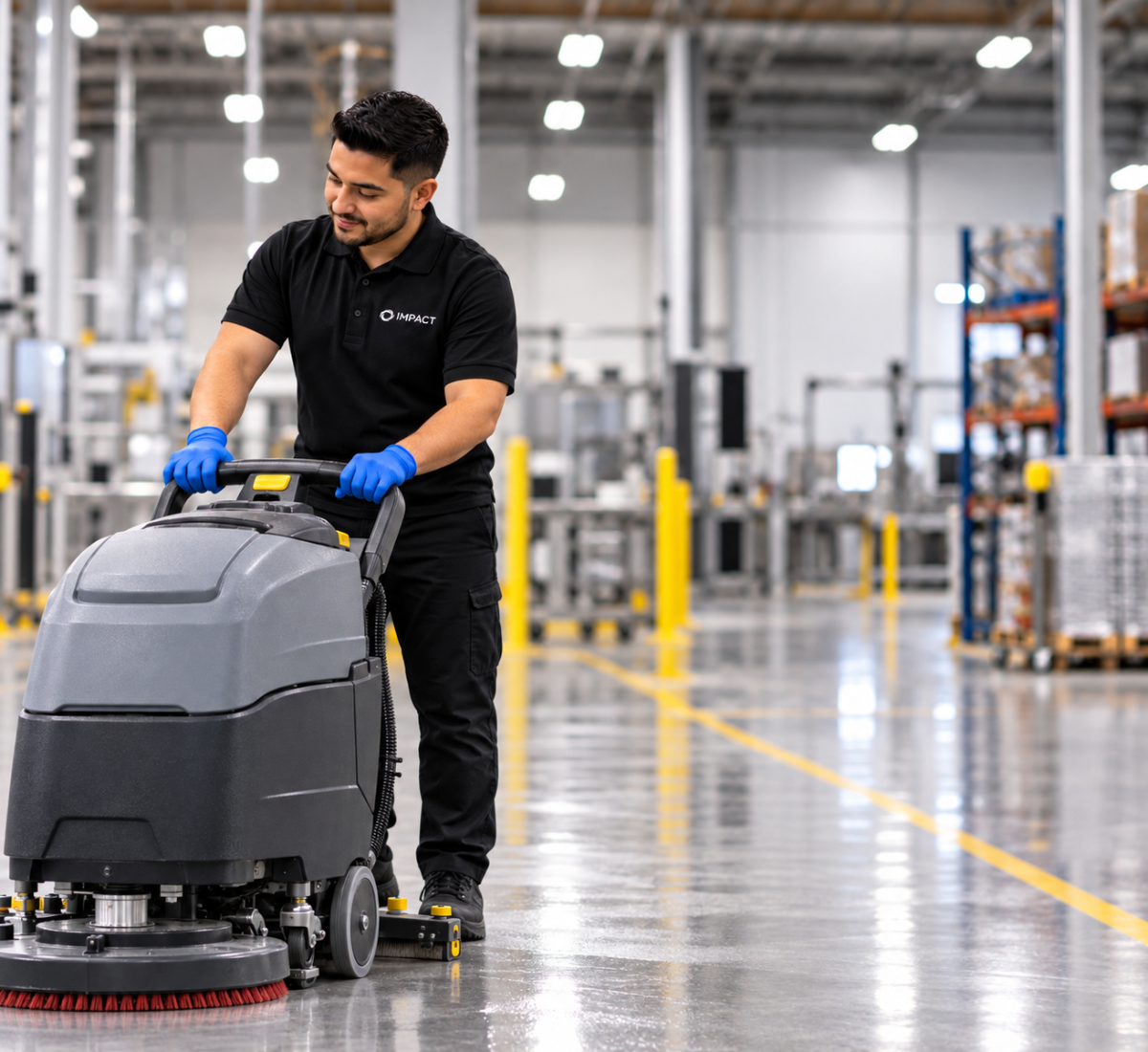
- Auto-scrub all hard floors in main aisles, dock areas and staging zones (see our industrial mopping and floor scrubbing service)
- Sweep under and behind racking on the lower levels where debris collects
- Clean forklift charging areas and check for battery acid residue or spilled electrolyte
- Wipe down rack beam faces, end caps and pallet positions at ground level
- Clean warehouse office windows, glass partitions and the exterior of equipment cabinets
- Deep-clean breakroom appliances and discard expired food from fridges
- Empty and wipe down waste bins, compactor areas and recycling stations
- Clean dock door windows and inspect door seals for damage
Monthly Warehouse Cleaning Tasks
Monthly tasks are the ones that typically fall off the schedule first, which is why they belong in a written program. These are also where a dedicated industrial cleaning crew usually earns its fee, because the work needs equipment an in-house team rarely has.
- High dusting of rack tops, beams, ledges, conduit and sprinkler lines in the aisles that see the most movement (industrial dusting)
- Clean light fixtures and lenses on the lower bays and in offices
- Degrease forklift paths, charging areas and any zone with recurring oil drips (industrial degreasing)
- Wipe down HVAC supply and return grilles and the housings of unit heaters and fans
- Clean interior walls at forklift height where tire marks and scuffs build
- Pressure-wash dock aprons, dumpster pads and exterior walkways
- Clean and inspect eyewash stations, safety showers and fire extinguisher cabinets
- Vacuum and wipe inside electrical rooms and IT closets
Quarterly and Annual Warehouse Cleaning Tasks
These are the big, scheduled jobs. Most are planned around inventory counts, plant shutdowns or slow seasons, because they need areas of the floor cleared and sometimes need lifts in the aisles.
- Full high-bay dusting of the entire structure: trusses, purlins, ductwork, sprinkler mains, rack tops across every aisle
- Clean skylights, clerestory windows and upper-level glazing
- Deep-scrub and, where specified, seal or re-coat concrete floors
- Exterior industrial pressure washing of walls, loading docks and trailer yards
- Clean conveyors, sortation equipment and packing stations in detail (industrial equipment cleaning)
- Clean the exterior of HVAC units, exhaust fans and louvers
- Inspect and clean floor drains, trench drains and oil-water separators
- Clean behind and under racking in the aisles that were not reachable during the year
How Often Should a Warehouse Be Cleaned?
There is no single answer, because a 20,000-square-foot parts warehouse with three employees and a 500,000-square-foot e-commerce fulfillment center are different buildings. The frequencies above are a reasonable baseline for a mid-sized warehouse running one or two shifts. Four things push them up or down:
- Forklift and foot traffic. More movement means more tire debris, more packaging on the floor and more frequent sweeping. Multi-shift operations usually sweep every shift.
- Product type. Paper, cardboard, grain, powders and textiles shed dust constantly and move high dusting from annual to quarterly or monthly. Sealed, palletized goods shed far less.
- Dock exposure. Open docks pull in dirt, leaves and moisture every time a trailer backs in. Buildings with many doors need dock areas cleaned daily.
- Regulatory and customer audits. Food, pharmaceutical, medical device and automotive supply warehouses are held to audit standards that effectively set the schedule for them.
A useful test is to walk the floor at the end of a shift and look at the aisle edges, under the first rack beam and at the base of the dock doors. If debris has built up in those three places, the daily routine is not keeping pace and the frequency needs to come up before the schedule gets any more detailed.
Special Cases: Food, Cold Storage and Combustible Dust
Food and beverage warehouses operate under FDA and USDA sanitation requirements on top of OSHA, with documented master sanitation schedules, allergen controls and pest management. The checklist above is the foundation, but the program needs to be written against the facility's food safety plan. Our food plant cleaning service covers that layer.
Cold storage and freezer warehouses add condensation, ice buildup at doors and on floors, and the constraint that most cleaning chemicals do not work below freezing. Floors need daily attention for ice, and dock doors and air curtains need their seals cleaned weekly to keep the refrigeration load down.
Facilities with combustible dust need high dusting on a documented schedule and should use explosion-rated vacuums rather than compressed air, which lifts dust into the air and creates the exact hazard the cleaning is meant to remove. If a warehouse handles powdered product and has never had a dust hazard analysis, that comes before the cleaning schedule. For production areas with machinery, our production facility cleaning team coordinates with lockout and tagout procedures so cleaning does not become its own hazard.
Building a Program That Survives a Busy Season
The reason warehouse cleaning programs fail is that they are usually assigned to operations staff as a secondary duty, and in peak season the secondary duty is the first thing dropped. The fix is either to protect the cleaning time on the schedule with a named owner, or to move the recurring work to a vendor whose crews do not get pulled to the pick line. Many facilities split the difference: operations handles daily sweeping and spills, and a contractor handles the weekly scrubbing and everything on the monthly and annual lists.

Whatever the split, write it down. Each task should have a frequency, an owner and a sign-off. Keep the completed sheets, because they are the first thing an inspector or auditor asks for, and because a spill that leads to an injury is a very different conversation when there is a log showing the floor was swept an hour earlier. The same logic applies to the front office, which we cover in our commercial office cleaning checklist, and to new or expanded buildings, where the post-construction cleaning checklist gets the space to a clean starting point before the recurring program takes over.
Frequently Asked Questions
Does OSHA require a written warehouse cleaning schedule?
Not in those words. OSHA requires that floors, aisles, exits and storage areas be kept clean, clear and free of hazards, and it cites employers who do not meet that standard. A written schedule is the most practical way to meet the requirement and the easiest way to demonstrate it during an inspection.
Can warehouse staff do the cleaning instead of a contractor?
Daily sweeping, spill response and housekeeping are normal duties for warehouse staff. Weekly floor scrubbing, high dusting, degreasing and pressure washing usually need equipment, lifts and training that operations teams do not have, which is where a contractor makes sense. The important thing is that every task has an owner.
What should be done after a major spill or a flood in a warehouse?
Stop the source, isolate the area, and bring in a crew equipped for the material. Oil, chemical and hazardous spills need containment and proper disposal, which is the work of an emergency spill cleanup team. Water intrusion from storms or a roof failure needs extraction and drying within the first day to protect inventory and the slab, as covered in our guide to storm resilience for Middle Tennessee facilities.
Put the Checklist on a Schedule
Impact Cleaning Services builds warehouse programs from this checklist, with each task assigned a frequency, a crew and a sign-off, and with the high-bay, degreasing and pressure-washing work scheduled around your operation rather than on top of it. We serve warehouses and distribution centers across Nashville and Middle Tennessee, with industrial crews equipped for high dusting, floor scrubbing and equipment cleaning.
For a site walk and a written schedule priced for your building, contact Impact Cleaning Services.