

Most janitorial companies market medical and dental office cleaning as one service. The two share a regulatory base. The daily work differs in ways that matter during an inspection. Nashville is a healthcare town. Practices on Charlotte Avenue in Green Hills and across from Cool Springs often face these questions.
Impact Cleaning Services has worked in healthcare settings across Middle Tennessee since 1954. This guide shows where the protocols split apart, and where medical office cleaning in Nashville is truly different work.
Why Do Medical and Dental Offices Need Different Cleaning Protocols?
Both settings operate under the same federal framework. The OSHA Bloodborne Pathogens Standard covers worker exposure. Both rely on EPA-registered hospital disinfectants and CDC Standard Precautions.
The divergence comes from what happens during treatment. Medical exam rooms see contamination in bursts, usually on set surfaces and instruments. Dental operatories emit airborne spray throughout a procedure. That spreads contamination over a much wider area.
CDC guidance for the two also sits in separate documents. Dental practices work from the Guidelines for Infection Control in Dental Health-Care Settings. Medical facilities use the Guideline for Disinfection and Sterilisation in Healthcare Facilities. A contractor citing only one has covered half the picture.
Who Cleans What, Clinical Staff or the Janitorial Contractor?
This boundary causes more compliance problems than any technical detail. CDC splits surfaces into two groups, and each has a different owner.
Clinical contact surfaces are high-touch items in the treatment area. They include light handles, bracket trays, dental unit switches, and computer equipment. Each must be barrier-protected or cleaned and disinfected between patients with an EPA-registered hospital disinfectant. That work belongs to trained clinical staff, not the evening cleaning crew.
Housekeeping surfaces are floors, walls, and sinks. CDC says plainly that these carry less risk than clinical contact surfaces. Soap and water is enough unless blood is visible. Teams at Impact Cleaning Services work mainly in this second group. A written scope should state exactly where the line sits.
How Does Aerosol Generation Change Dental Office Cleaning?
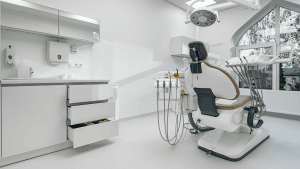
High-speed handpieces, air and water syringes, and ultrasonic scalers produce spray throughout treatment. That spray carries saliva, blood, and tooth debris well past the chair.
The result is a bigger contamination footprint. In a medical exam room, it gathers around the table and a few instruments. In a dental operatory, it settles on counters, cabinet fronts, light fixtures, and floors several feet away.
Cleaning sequence changes accordingly. Aerosols need time to settle before non-clinical staff enter an operatory. Cleaning schedules should be built around treatment hours, not against them. Good dental office cleaning programs treat the whole operatory edge as a contamination zone, not just the chair.
Nashville practices that compare janitorial proposals often find the scope silent about where clinical responsibility ends. Call
(615) 392-4548
or use the contact page to arrange a walkthrough of the practice, and receive a written scope that separates housekeeping surfaces from clinical contact surfaces task by task.

Which Surfaces and Frequencies Differ Between the Two Settings?
The table below sets the two side by side. Frequencies assume a typical Nashville outpatient practice.
| Area | Medical Office | Dental Office |
|---|---|---|
| Treatment surface turnover | Between patients, clinical staff | Between patients, clinical staff |
| Contamination zone | Localized to exam table and instruments | Wide, across operatory perimeter |
| Floors in treatment areas | Daily, damp mop | Daily, with attention to spray fallout |
| Cabinet fronts and counters | Daily | Daily, higher touch and spray load |
| Waiting room and reception | Daily | Daily |
| Restrooms | Daily, disinfect fixtures | Daily, disinfect fixtures |
| Sterilization or lab area | Daily, clinical oversight | Daily, clinical oversight |
| Air vents and light fixtures | Quarterly | Monthly, due to aerosol fallout |
| Terminal deep clean | Quarterly | Quarterly, extended operatory scope |
Two rows carry most of the difference. Dental practices need high surfaces cleaned more often, because aerosols settle up and outward. Operatory edges need daily attention rather than periodic. Scopes written by Impact Cleaning Services reflect that split in the task list. Well-structured daily janitorial cleaning never treats the two settings as identical.
Which Disinfectants and Contact Times Apply in Each Setting?
Product selection follows the same rules in both settings, and the errors are also the same. Three points govern compliance.
Use EPA-registered hospital disinfectants with label claims for health care settings. Where blood is visibly present, an intermediate-level product with a tuberculocidal claim is required. Ordinary commercial cleaners do not meet either standard.
Cleaning must precede disinfection every time. Blood and saliva shield germs and weaken the disinfectant. A single wipe over a soiled surface does little. CDC also warns against using disinfectants as cleaners unless the label allows it.
Contact time is where most crews fail. Every product lists a dwell time on the label, often one to ten minutes. A surface wiped dry before that time has not been disinfected. Any contractor in healthcare should be able to state the contact time of every product they carry.
What Is Dental Unit Water Quality and Who Is Responsible?
Dental unit waterlines have no match in a medical office. Facility managers often misread who owns them. The plastic tubing feeding handpieces, syringes, and scalers grows biofilm inside.
CDC sets a clear standard. Dental treatment water must meet drinking water quality, defined as 500 CFU per mL or fewer of heterotrophic water bacteria. Water bottle reservoirs alone do not reach that mark. Practices need a treatment and monitoring plan from the unit maker.
Responsibility sits with the dental practice, not the cleaning contractor. Naming it in the scope still matters. A manager who assumes the janitorial vendor handles waterlines has a gap nobody is covering.
How Do Waste Streams Differ Between Medical and Dental Offices?
Both settings make regulated medical waste, and both must keep it out of general refuse. Volume and content differ enough to warrant a change in handling.
Medical offices tend to produce more sharps and soiled dressings. Some also carry drug waste, which has its own disposal rules. Dental offices make fewer sharps but add materials with no medical match. Extracted teeth and amalgam waste both have their own rules.
Cleaning crews should never handle sharps containers or regulated waste unless specifically contracted and trained for it. Practices wanting that service should confirm it in writing. Compliant biohazard waste disposal is a separate scope with its own paper trail.
What Training Should a Nashville Cleaning Contractor Provide?
CDC defines dental health care personnel broadly. The term covers housekeeping and maintenance staff who may be exposed to hazards at work. Cleaning crews in these settings are covered personnel, not incidental vendors.
- OSHA Bloodborne Pathogens training, completed annually with records retained
- Hepatitis B vaccination offered to staff with occupational exposure risk
- Product-specific training on contact times and dilution for every disinfectant carried
- Clear instruction on which surfaces crews do and do not touch
- Correct PPE selection and sequence for the setting
- Spill response procedure for blood and other potentially infectious material
- Documented supervisor verification, not just a signed attendance sheet
Ask for training records before signing rather than after an inspection. A contractor who cannot produce dated records for the assigned crew creates liability that lands on the practice.
Which Mistakes Cause Compliance Problems Most Often?
Four errors recur across both settings. Each is a scope or training problem rather than a budget one.
Blurring the clinical boundary is the most serious. Crews disinfecting clinical contact surfaces leaves a gap. So does clinical staff assuming the contractor covered them. The CDC sterilization and disinfection guidance sets out which surfaces need between-patient attention and which do not. A scope document should mirror that split.
Ignoring contact time is second, and it is invisible during a walkthrough. The third is using one product everywhere. A disinfectant fit for a restroom floor may lack the claims needed near treatment areas.
The fourth is treating dental practices as small medical offices. Aerosol load, operatory edges, and waterline rules have no medical match. A scope copied from a clinic contract misses all three.
Choosing a Contractor for a Nashville Healthcare Practice
The right contractor can describe the line between clinical and housekeeping surfaces without being asked. They carry EPA-registered products with stated contact times. They hold current bloodborne pathogen records, and write scopes that name tasks rather than areas. Practices that check those four things before signing rarely face compliance surprises later.
That standard applies across every commercial setting, from treatment rooms to the routines behind office cleaning in downtown Nashville. Impact Cleaning Services applies the same documentation discipline in a dental practice, a clinic, and a corporate floor alike.
Nashville practices comparing proposals can reach Impact Cleaning Services at
(615) 392-4548
or through the
contact page
for a practice assessment. The walkthrough covers surface classification, product selection, training documentation, and a written scope that separates clinical responsibility from janitorial responsibility.
Frequently Asked Questions
Can the same cleaning company service both a medical and a dental office?
Yes, provided the scope is written separately for each setting. The rules are shared, but dental sites need wider contamination zones covered and elevated surfaces cleaned far more often. A scope copied from one setting to the other usually misses the dental-specific items altogether.
Should a janitorial crew disinfect dental operatory surfaces between patients?
No. Clinical contact surfaces, such as light handles, bracket trays, and unit switches, must be barrier-protected or disinfected between patients by trained clinical staff. Janitorial crews handle housekeeping tasks on surfaces such as floors, walls, and sinks. The written scope should state that line clearly.
What disinfectant is required in a Nashville medical or dental office?
An EPA-registered hospital disinfectant with label claims for health care settings. Where blood is visible, an intermediate-level product with a tuberculocidal claim is needed. Ordinary commercial cleaners do not qualify, and each product needs its labelled dilution and full contact time.
Is a cleaning contractor responsible for dental unit waterline maintenance?
No, that duty lies with the dental practice itself, in accordance with the unit manufacturer’s protocol. CDC requires that treatment water contain no more than 500 CFU/mL of heterotrophic bacteria. It still belongs in the written scope, so no facility manager assumes the janitorial vendor covers it.
Does a cleaning crew in a dental office need bloodborne pathogen training?
Yes. CDC’s definition of dental health care personnel includes housekeeping and maintenance staff who may have workplace exposure. OSHA requires annual bloodborne pathogen training with records kept. Practices should request dated records for the specific crew assigned before a contract starts.
How often should a dental office receive a deep clean compared with a medical office?
Both usually need quarterly terminal cleaning, though the dental scope runs wider. Aerosol fallout means operatory edges, cabinet fronts, light fixtures and air vents need attention a medical exam room does not. Many Nashville practices schedule dental vent and fixture cleaning monthly instead.